Discover Nuremberg on your own: this self-guided city tour takes you through the most important places in the old town in around six hours – from the medieval imperial city to today’s cityscape. We recommend starting at 10:00 a.m. so that you reach the main market square around 12:00 p.m. and can experience the Männleinlaufen (little men running) at the Frauenkirche. The route is easy to walk, flexible, and allows enough time for breaks, visiting the market, and lunch. Ideal for anyone who wants to discover Nuremberg at their own pace, but with historical context.
Stop 1
Königstraße 82
90429 Nuremberg
You begin your tour at Nuremberg Central Station, the city’s main transportation hub. From here, you walk onto the large forecourt and head straight for the Königstor (King’s Gate). Even at this point, it is clear that Nuremberg’s old town is clearly separated from its surroundings: the medieval city wall ran here and marked the boundary between the city and the surrounding area for centuries. Today’s Königstor dates back to the 19th century and was built in connection with the construction of the railway, but it replaces older gate structures.
Stop 2
Lorenzer Platz 1
90403 Nuremberg
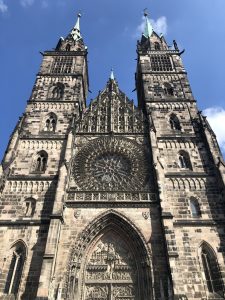
You are now following Königstraße, one of the most important east-west axes in the old town. This street was already a main route for traders and travelers in the Middle Ages. Today, it connects historic buildings with modern urban functions and leads you directly to Lorenzer Platz.
There you will find the Lorenzkirche (St. Lorenz), a monumental Gothic civic church. Construction began in the 13th century and continued into the 15th century. St. Lorenz was not a cathedral, but rather an expression of the self-confidence of the wealthy citizenry. If the church is open, it is worth taking a quick look inside. Particularly worth seeing is the Sakramentshaus (Tabernacle) by Adam Kraft (1493–1496), a stone work of art over 20 meters high that testifies to great craftsmanship and artistic precision.
Stop 3
Museumsbrücke
90403 Nuremberg
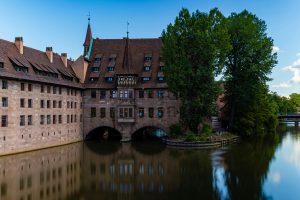
Next, walk towards the Pegnitz River. The best route is from Lorenzer Platz to the Museumsbrücke (or one of the nearby bridges) and then cross the river. The branches of the Pegnitz and the bridges still characterize Nuremberg today: you are now at one of the most photogenic spots in the old town, because right in front of you is the Heilig-Geist-Spital (Holy Spirit Hospital), which seems to stand “above” the water. The hospital dates back to a foundation established by the Nuremberg patrician Konrad Groß; the foundation was officially confirmed in 1332, and the complex developed into one of the city’s most important welfare institutions in the 14th century. Historically, it served as a residence and care facility for the needy, the elderly, and the sick, among others—an indication of how organized urban social welfare could already be in the late Middle Ages.
Stop 4
Hauptmarkt
90403 Nuremberg
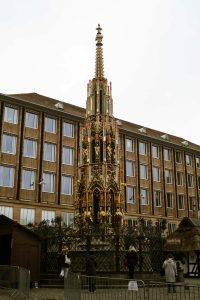
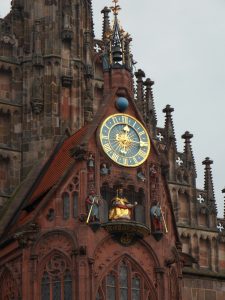
A few steps further on is the Main Market Square, the heart of the old town. On Saturdays, the weekly market takes place here, making the square particularly lively. The Main Market Square is not only the economic center of Nuremberg, but also its symbolic center.
The Schöne Brunnen (Beautiful Fountain), one of the city’s most important Gothic structures, stands on the Main Market Square. It was built between 1385 and 1396 and is around 19 meters high. The fountain depicts the medieval world order in the form of 40 figures – from philosophers and evangelists to electors and allegorical figures.
Important to know: The fountain you see today is a historically accurate copy. The original is protected for conservation reasons. The gilded ring grille is particularly well known. One of the rings can be turned – a Nuremberg tradition says that this brings good luck.
The Frauenkirche is also located directly on the main market square. It was built on behalf of Emperor Charles IV in the 14th century and is closely linked to imperial politics. Particularly well-known is the artistic clock with the “Männleinlaufen” (little men running) from 1509: every day at 12 noon, the electors pass by the figure of Charles IV. If you plan your tour at the right time, this is a moment well worth seeing.
Stop 5
Winklerstraße 26
90403 Nuremberg
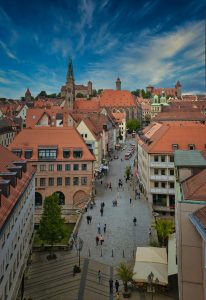
After the break, continue north to Sebalduskirche (St. Sebald). It is the oldest parish church in Nuremberg and is dedicated to the city’s patron saint, Sebaldus. Construction began in the 13th century. Particularly worth seeing is the Sebaldus tomb by Peter Vischer the Elder and his sons, a major work of Nuremberg Renaissance bronze art.
In the immediate vicinity is the Nuremberg City Hall, whose Renaissance building was constructed in the early 17th century. It is a reminder that Nuremberg was a free imperial city with extensive self-government for a long time.
Stop 6
Kaiserburg
90403 Nuremberg
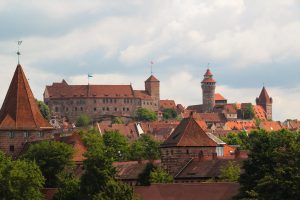
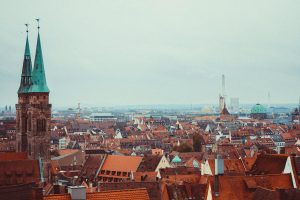
From here, follow the signs to the Imperial Castle. The path leads slightly uphill and already makes it clear why this place was so strategically important. The Imperial Castle of Nuremberg sits enthroned on a sandstone rock above the old town and is one of the most important imperial palaces of the Holy Roman Empire. Its origins date back to the 11th century; for centuries it served as a residence for traveling kings and emperors. Nuremberg was a central location for the administration of the empire, where documents were issued and political decisions were prepared. The castle complex combines military, representative, and administrative functions and consists of several buildings, including the Imperial Castle and the Burgrave’s Castle. Particularly striking is the 13th-century Sinwell Tower, which offers a sweeping view of the entire old town. The Deep Well, which reaches over 50 meters into the rock and ensured the castle’s water supply, is a technical masterpiece. From up here, it becomes clear why Nuremberg was one of the most important cities in the empire for centuries.
Stop 7
Albrecht-Dürer-Straße 39
90403 Nuremberg
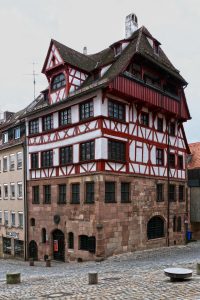
Finally, walk down from the castle to Tiergärtnertorplatz. There you will find the Albrecht Dürer House, where Dürer (* 1471, † 1528) lived and worked from 1509 to 1528. The house is one of the few town houses in Nuremberg from this period that has been largely preserved in its original form.
Even without visiting the interior, the square is an ideal place to end your tour: lively, with a view of the castle and plenty of opportunities to linger.